
Complete Guide to Garage Door Opener Installation in Plain City, OH
Published by A1 Garage Repair LLC
Choosing an opener comes down to drive type, the weight and condition of your door, and the features you will use. A correct installation then sets the travel, force and safety sensors so the door reverses when it should.
Check the door before you choose an opener
An opener moves the door, but the springs carry its weight. If the springs are weak or the door is binding, a new opener will struggle from the first day and wear out early.
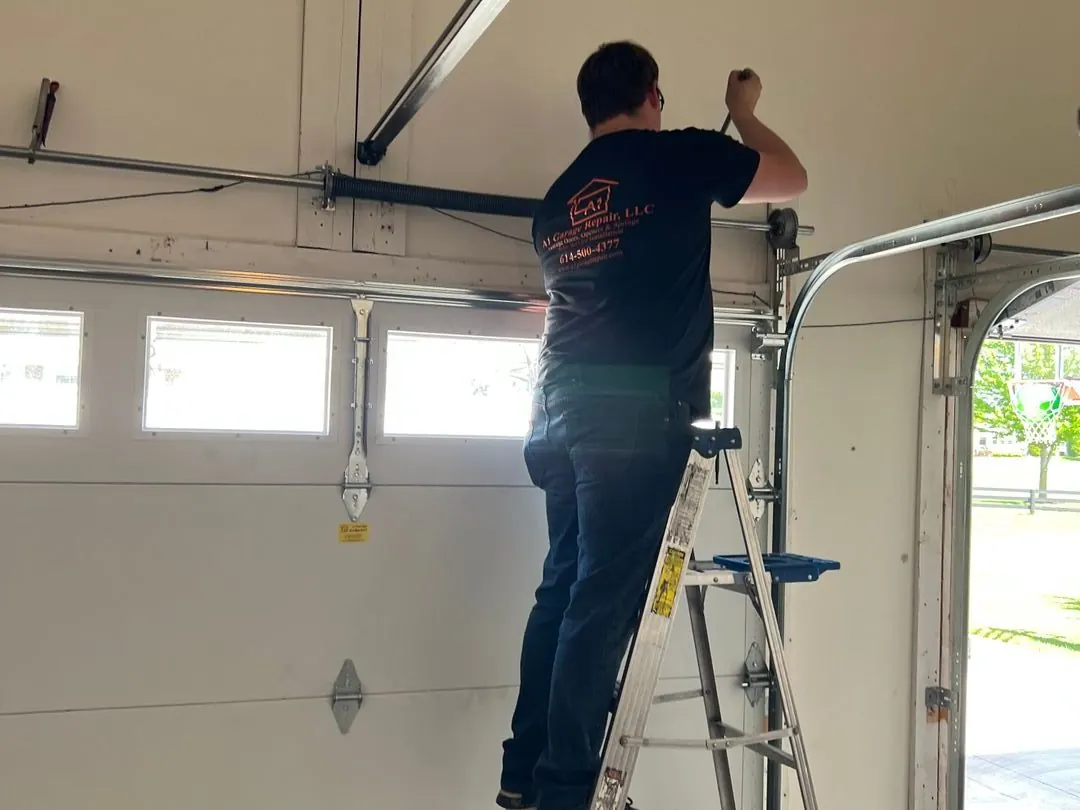
A technician tests this by disconnecting the opener and lifting the door by hand. It should move freely and stay where it is left at the halfway point. If it does not, the springs, rollers or tracks need attention first. Spring adjustment is high-tension work and should be left to a trained technician.
The four drive types and where each fits
Openers are grouped by how the motor moves the door.
A technician can tell you which of these your garage will accept. Ceiling height, the space above the door and the spring type all limit the options.
- Chain drive: a metal chain pulls the trolley along the rail. It is durable and usually the lowest-priced type, and it is the loudest. It suits detached garages.
- Belt drive: a reinforced rubber belt does the same job with much less noise and vibration. It is the usual pick when a bedroom or living space sits above or beside the garage.
- Screw drive: a threaded steel rod turns to move the trolley. It has few moving parts and needs periodic lubrication.
- Wall-mount, also called jackshaft: the unit mounts on the wall beside the door and turns the torsion shaft directly. It leaves the ceiling clear and runs quietly, and it needs a torsion spring system and some wall space next to the door.
Motor power and features worth having
Motor strength is matched to the door. A single steel door needs less than a wide, insulated or wood door. More power than the door needs does no harm, but it is not a fix for a door that is out of balance.
Many current openers use DC motors, which start and stop gently and allow battery backup. A battery lets you run the door for a while during a power outage. Other features to consider:
- Rolling-code remotes that change the signal each time the button is pressed
- Wi-Fi control, so you can check and operate the door from a phone
- A wall control with a lock button that disables the remotes while you are away
- Motion-activated LED lighting
- An automatic deadbolt on some wall-mount models
What the installer does on installation day
The old opener and rail come down first. The new rail is assembled and mounted to the header above the door, and the motor unit is hung from the ceiling framing with solid angle brackets so it cannot sway.
The arm is then attached to the top section of the door. That section should have a reinforcement bracket or strut, because an opener pushing and pulling on bare sheet metal will eventually crack it. The wall control and photo eyes are wired, and the remotes, keypad and any phone app are programmed.
Finally, the installer sets the travel limits so the door stops fully open and seals at the floor without slamming, and adjusts the force so the opener does not push harder than the door requires.
Safety sensors and the auto-reverse test
Every modern opener has two safeguards. Photo eyes mounted a few inches above the floor on each side of the opening send a beam across it. If anything breaks the beam while the door is closing, the door stops and goes back up.
The second is contact reversal. If the closing door meets an obstruction, the opener senses the resistance and reverses. The installer tests it by laying a board flat on the floor in the door’s path and closing the door on it.
Run both tests yourself once a month. If the door fails either one, stop using the opener and have it serviced. Never disable or bypass the sensors, and keep the wall button out of reach of small children.
When to replace an opener, and what the job costs
Repair makes sense when the fault is a worn gear, a sensor or a remote. Replacement makes more sense when the unit has no photo eyes, parts are no longer available, the motor is failing, or you want quieter operation and phone control.
The cost depends on the drive type, motor size, rail length for taller doors, accessories such as keypads and battery backup, and any door repairs needed first. A1 Garage Repair LLC installs LiftMaster and Genie openers and gives free estimates on new openers in Plain City. We explain the price before the work begins. Call (614) 500-4377 or send a request online.
Have the door’s balance checked first, choose the drive type that suits your garage and noise tolerance, and make sure the installer tests the photo eyes and auto-reverse before leaving.
Related service: Garage Door Opener Installation